In many Indian offices, managers often judge productivity based on how busy employees look. If someone stays late, attends many meetings, or is always active on WhatsApp, they are considered productive.
But the truth is different.
Productivity is not about hours worked. It’s about results delivered.
An employee working 6 focused hours can produce more than someone working 10 distracted hours.
That’s why measuring team productivity properly is critical. It helps businesses identify top performers, fix inefficiencies, and improve overall performance.
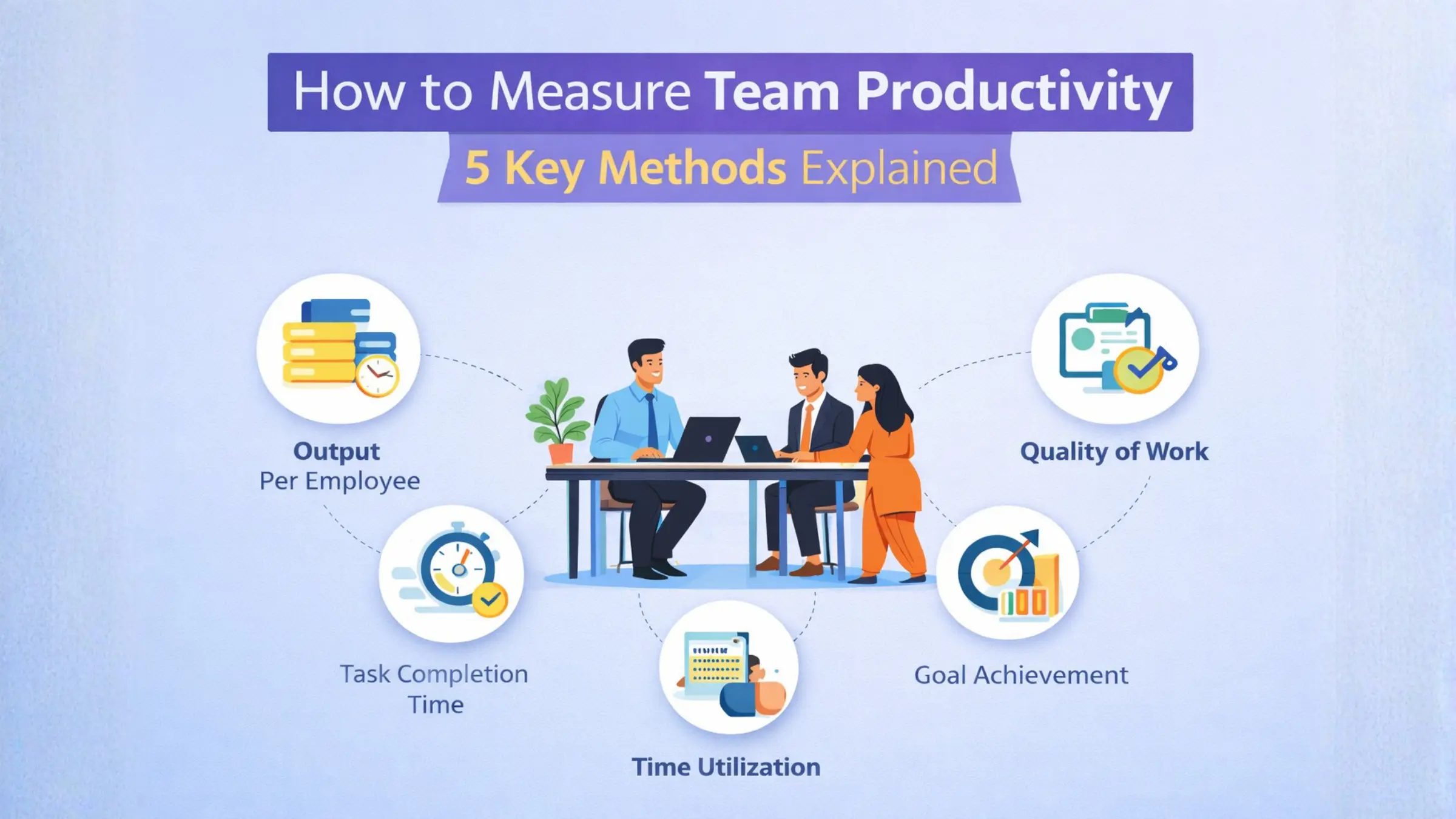
In this guide, you’ll learn 5 practical and proven methods to measure team productivity, with real examples from Indian workplaces.
What Is Team Productivity?
Team productivity means how efficiently your team converts time and effort into useful output.
Example:
If a sales team makes 100 calls and closes 20 deals → high productivity
If they make 100 calls and close 3 deals → low productivity
Same effort. Different output.
Why Measuring Productivity Is Important
Without measurement, managers rely on assumptions.
When productivity is tracked properly, businesses can:
- Identify inefficient processes
- Improve employee performance
- Reduce operational costs
- Make better hiring decisions
- Increase profits
Companies that measure productivity grow faster than those that don’t.
5 Key Methods to Measure Team Productivity
Method 1: Measure Output Per Employee
This is the simplest and most effective method.
Measure how much work each employee completes in a specific time.
Example (Indian Digital Marketing Agency):
Content writer A → writes 4 blogs per week
Content writer B → writes 2 blogs per week
Writer A is more productive.
Common Output Metrics:
- Sales closed per employee
- Tasks completed per day
- Tickets resolved per support agent
- Projects completed per month
This method works in almost every industry.
See Where Your Team’s Time Really Goes – Try It Free
Method 2: Measure Task Completion Time
This method focuses on how fast work gets done.
Example:
Two designers create the same poster.
Designer A → takes 5 hours
Designer B → takes 2 hours
Designer B is more efficient.
Why This Matters in India
Many companies face delays because tasks take longer than expected.
Tracking completion time helps:
- Identify delays
- Improve planning
- Increase efficiency
Method 3: Measure Quality of Work
Productivity is not just speed. Quality matters equally.
Fast work with poor quality creates rework.
Example:
Employee A completes task in 2 hours but makes mistakes
Employee B completes in 3 hours with perfect accuracy
Employee B is more productive overall.
Quality Metrics Examples:
- Error rate
- Client satisfaction
- Revision frequency
- Complaint rate
High productivity = Fast + Accurate
See Where Your Team’s Time Really Goes – Try It Free
Method 4: Measure Goal Achievement
Every employee should have defined goals.
Example:
Sales Executive Target → ₹5 lakh per month
If employee achieves:
₹6 lakh → highly productive
₹5 lakh → productive
₹2 lakh → low productivity
Goal tracking gives clear performance visibility.
This Method Is Very Popular In:
- Sales teams
- Marketing teams
- Recruitment teams
Because targets are easy to measure.
Method 5: Measure Time Utilization
This method tracks how much time employees spend on productive work vs non-productive work.
Example:
Employee works 8 hours:
Productive work → 6 hours
Meetings / distractions → 2 hours
Productivity utilization = 75%
This helps identify:
- Time wastage
- Distractions
- Workflow problems
Real Example: Indian IT Company
Problem:
Projects delayed despite employees working full hours.
After measuring productivity, they found:
- 30% time wasted in unnecessary meetings
- 20% time wasted waiting for approvals
After fixing these issues, productivity increased by 40%.
Struggling to Track Team Productivity Accurately?
Use a Free Workforce Management Tool to Get Real-Time Productivity Insights
Common Mistakes Indian Managers Make
Avoid these mistakes:
Mistake 1: Judging Productivity by Working Hours
Long hours do not equal high productivity.
Output matters more.
Mistake 2: Not Setting Clear Goals
Without goals, productivity cannot be measured.
Employees need clear targets.
Mistake 3: Ignoring Data
Many managers rely on assumptions instead of reports.
Data reveals real performance.
Mistake 4: Micromanagement
Micromanagement reduces productivity.
Trust + tracking works better.
Best Productivity Metrics to Track (Quick List)
You can track:
- Tasks completed
- Sales generated
- Time taken per task
- Error rate
- Goal achievement percentage
- Client satisfaction
These metrics give full productivity visibility.
How Often Should You Measure Productivity?
Recommended frequency:
Daily → operational teams
Weekly → managers
Monthly → business performance
Regular tracking ensures continuous improvement.
Benefits of Measuring Team Productivity
When productivity is tracked properly, businesses see:
- Faster work completion
- Better employee performance
- Less time waste
- Higher profits
- Better team accountability
Measurement improves performance automatically.
Conclusion
If you cannot measure productivity, you cannot improve it.
Successful Indian businesses focus on results, not attendance.
By tracking output, time, quality, goals, and utilization, companies can identify inefficiencies and improve performance quickly.
Productivity measurement is not about controlling employees.
It’s about helping them perform better.
Businesses that measure productivity grow faster, scale faster, and succeed faster.
FAQs: How to Measure Team Productivity
1. What is the best way to measure employee productivity?
The best way is to track output, task completion time, and goal achievement. These give accurate performance insights.
2. How do companies track productivity?
Companies use productivity tracking tools, performance reports, and goal tracking systems.
3. Does working more hours mean higher productivity?
No. Productivity depends on output, not working hours.
4. Why is productivity tracking important?
It helps improve performance, reduce inefficiencies, and increase profits.
5. Can productivity tracking improve business growth?
Yes. Businesses that track productivity grow faster because they fix inefficiencies quickly.
Leave a Reply